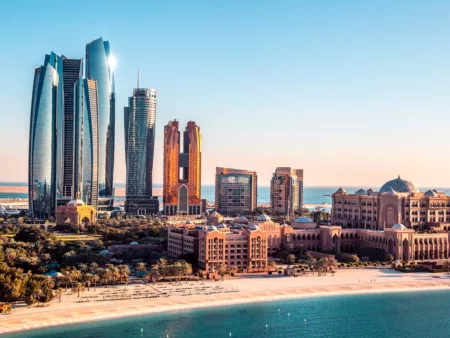

For decades, the idea of a casino resort in the UAE sat in the same category as snowstorms in August — discussed, speculated about, but fundamentally incompatible with the country’s identity.
That assumption is now obsolete.
Rising from reclaimed land off the coast of Ras Al Khaimah, Wynn Al Marjan Island is no longer a rumour, a loophole, or a hypothetical. It is a fully financed, government-approved integrated resort under construction, scheduled to open in 2027, and set to become the first major casino resort in the history of the United Arab Emirates.
This is not just a property development story. It is a policy story, a tourism story, and a signal — carefully calibrated — about where the UAE is willing to go next.
Why Ras Al Khaimah — and not Dubai
The most misunderstood aspect of Wynn Al Marjan is where it is being built.
Ras Al Khaimah is not Dubai’s understudy. It is its counterbalance.
Less densely populated, less globally scrutinised, and historically more flexible in industrial and tourism experimentation, Ras Al Khaimah offers something Dubai no longer can: room to test policy at scale without reputational shockwaves.
For the federal government, RAK provides the perfect proving ground:
-
International enough to attract global operators
-
Contained enough to manage social and regulatory risk
-
Ambitious enough to pursue economic differentiation
The casino is not despite Ras Al Khaimah. It is because of it.
The operator matters more than the casino
If the UAE was ever going to allow a casino resort, the operator had to be unimpeachable.
Enter Wynn Resorts.
Wynn is not the largest casino company in the world — but it is arguably the most disciplined. Its brand is built on regulatory compliance, luxury positioning, and a track record of operating in tightly controlled jurisdictions such as Las Vegas, Macau, and Singapore.
For UAE authorities, this was critical.
Wynn Al Marjan is not being treated as a gambling venue with a hotel attached. It is being framed as a luxury integrated resort in which gaming is only one component — and, crucially, one that can be governed with precision.
That framing is not semantic. It is strategic.
What “integrated resort” really means in the UAE context
In Western markets, “integrated resort” is often marketing language. In the UAE, it is a regulatory condition.
Wynn Al Marjan is expected to include:
-
A five-star luxury hotel with over 1,000 rooms
-
High-end dining curated for international tourism
-
Convention, retail, and entertainment facilities
-
Beachfront leisure infrastructure
-
A single, tightly regulated casino floor
Gaming is designed to be contained, supervised, and proportionate — not dominant.
This mirrors the UAE’s approach elsewhere: alcohol served only in licensed venues, financial innovation limited to regulated free zones, digital assets governed by bespoke authorities.
The casino does not lead the resort. It is embedded within it.
The regulator behind the scenes
None of this exists without the quiet but decisive emergence of the General Commercial Gaming Regulatory Authority (GCGRA).
Established in 2023, the GCGRA was created with a remit broad enough to cover:
-
Lotteries
-
Online gaming and sports wagering
-
Land-based commercial gaming
Wynn Al Marjan is the first true test of that authority’s credibility.
This is not a permissive licence. It is a bespoke framework designed to:
-
Define who can access gaming
-
Control how money flows
-
Enforce compliance through revocation power
In short, the casino exists because regulation exists, not the other way around.
Cultural sensitivity by design, not apology
Critics often frame the casino question as a cultural contradiction. That misunderstands how policy works in the UAE.
This is not a reversal of values. It is a compartmentalisation of activity.
Access is expected to be:
-
Restricted by age
-
Restricted by location
-
Restricted by identity verification
-
Restricted by behaviour monitoring
There is no evidence — nor expectation — of mass-market gambling adoption. The model is tourism-led, not population-led.
That distinction is everything.
Economic impact: modest on paper, massive in signal
In raw numbers, Wynn Al Marjan will not transform the UAE economy. Oil revenues, logistics, finance, and aviation still dwarf it.
But symbolically, its impact is outsized.
It tells global investors three things:
-
The UAE can regulate what others only prohibit
-
Policy evolution here is deliberate, not reactive
-
New sectors are opened only when governance is ready
Already, international operators are watching closely — not for immediate replication, but for regulatory cues.
Dubai, in particular, is observing without committing. And that, too, is deliberate.
Why Dubai hasn’t moved — yet
Dubai does not need to rush.
It already dominates global tourism without casinos. It already attracts capital without gaming revenue. Its brand risk is higher — and its upside, marginally lower.
If Ras Al Khaimah succeeds, Dubai gains optionality without exposure.
If it fails, Dubai retains plausible distance.
This is asymmetric policymaking at its finest.
The long view: what 2027 really represents
Wynn Al Marjan will open its doors in 2027 — but the decision it represents was made years earlier.
This resort is the end product of:
-
Gradual legal groundwork
-
Federal-level regulatory architecture
-
Careful operator selection
-
Emirate-level political alignment
It is not the beginning of gambling in the UAE.
It is the beginning of controlled, state-designed commercial gaming — on Emirati terms.
Final thought
When Wynn Al Marjan opens, headlines will focus on roulette wheels, gaming floors, and first bets placed.
But the real story will not be happening inside the casino.
It will be happening in the fact that the UAE built one at all — slowly, quietly, and entirely on its own terms.